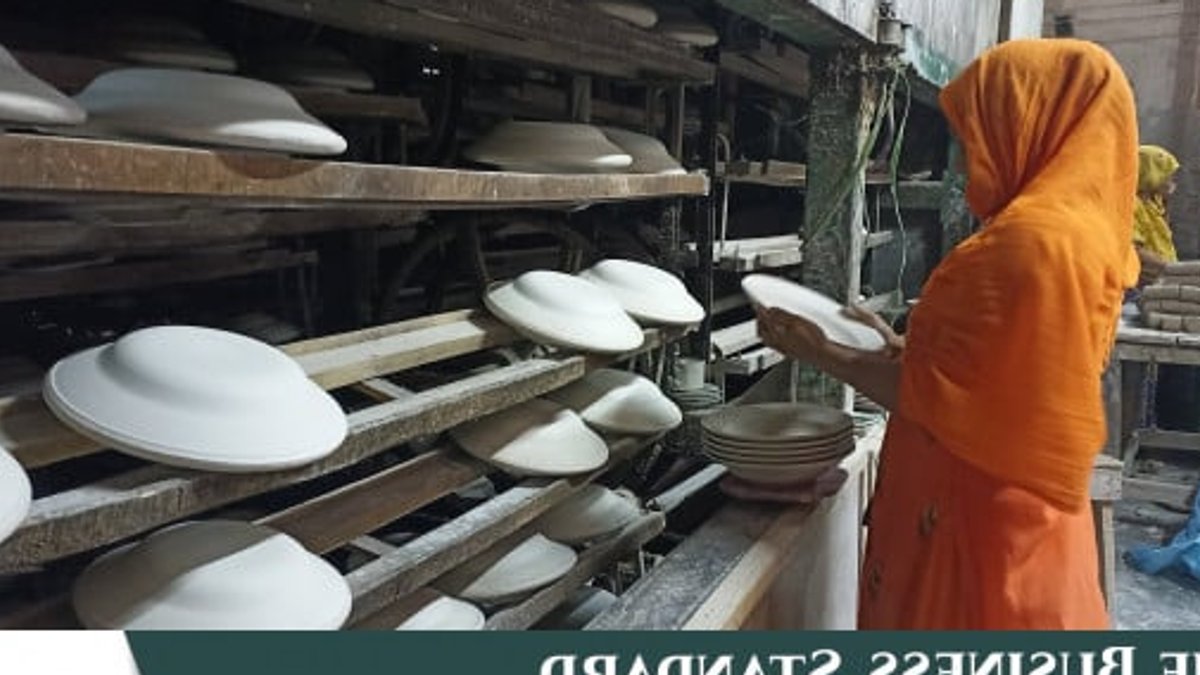
Bangladesh’s ongoing gas and electricity crisis is taking its toll on energy-intensive manufacturing industries, with the plastic and ceramic sectors among the worst affected. Production has fallen sharply, many factories are operating at less than half of their installed capacity, while some have temporarily suspended operations. Industry leaders say severe gas shortages and low pipeline pressure have disrupted production schedules, while frequent power outages have further compounded the situation. The decline in domestic gas production, increased dependence on imported liquefied natural gas (LNG), and the recent technical failure of a Floating Storage and Regasification Unit (FSRU) have created an estimated 450 million cubic feet per day (mmcfd) shortfall in national gas supply. As a result, gas pressure in major industrial zones has dropped significantly, disrupting factory operations.
Almost every production process in the plastic industry, including injection moulding, blow moulding and extrusion, relies on uninterrupted gas and electricity. Frequent power outages and inadequate gas supply have made it difficult even to operate backup generators, forcing many manufacturers to rely on expensive diesel-based power generation and pushing up production costs. According to the Bangladesh Plastic Goods Manufacturers and Exporters Association (BPGMEA), around 300 plastic factories have already suspended production due to disruptions in raw material supplies, prolonged gas and power shortages, and shortages of working capital. Most of the affected factories are small and medium-sized enterprises (SMEs).
Association President Shamim Ahmed said many plastic factories are currently operating at only 30-40% of their capacity.
“The industry cannot survive without reliable energy. Bangladesh must accelerate the adoption of renewable energy. Even if a factory can operate just one machine with solar power, it would help keep production running,” he said.
Senior vice president of the association KM Iqbal Hossain said the price of a 25-kilogram bag of polyethylene terephthalate (PET) resin has increased from around Tk3,000 to nearly Tk5,200 over the past few years, representing a 73% increase. During the same period, however, manufacturers have been able to raise product prices by only 5-10%.
“Many companies are already operating at a loss because of rising raw material costs. The gas crisis has made matters worse. In many factories, gas pressure is too low to operate generators, meaning production comes to a complete halt during power outages,” he said.
Ceramic manufacturers struggle to keep kilns running
For ceramic manufacturers, gas is a critical production input. Kilns used to manufacture tiles, tableware and sanitary ware require continuous high-temperature operation. Any sudden drop in gas pressure lowers kiln temperature and can ruin an entire production batch. Rasheed Mymunul Islam, vice president of the Bangladesh Ceramic Manufacturers and Exporters Association (BCMEA), told The Business Standard that many factories are receiving insufficient gas.
“Gas pressure is so low that many ceramic factories are operating at only 20-30% capacity. Continuous high temperatures are essential for kiln operations, and low gas pressure creates serious production problems,” he said.
He added that switching to LPG is not a practical solution because it significantly increases production costs, while intense competition in export markets leaves little room to pass those costs on to buyers.
“At this stage, survival has become the industry’s biggest challenge,” he said.
Muhammad Shahidul Islam, company secretary of RAK Ceramics (Bangladesh) told TBS that ceramic factories require at least 25 PSI gas pressure to operate kilns and other machinery efficiently, but pressure frequently falls to 8-10 PSI.
“When gas pressure suddenly drops, kiln temperatures cannot be maintained. Raw materials and semi-finished products inside the production line are damaged, and entire production batches often have to be scrapped. This is happening several times a day,” the official said.
“As a result, manufacturers are suffering losses from wasted raw materials while product quality is also deteriorating. That increases production costs and makes it difficult to deliver export orders on schedule.”
Export competitiveness, investment at risk
Industry leaders warn that the energy crisis is also discouraging new investment and expansion. Many factories have delayed expansion plans because of uncertainty over gas availability, while new industrial projects are struggling to begin production due to inadequate gas supply. Riad Mahmud, president of the Bangladesh Association of Publicly Listed Companies (BAPLC), said the plastic manufacturing industry is losing its footing in the international market due to the gas crisis.
“International buyers are increasingly turning to Vietnam because we cannot deliver on time. This poses a serious risk not only to current exports but also to Bangladesh’s long-term market position,” he said.
Bangladesh’s ceramic products are exported to more than 100 countries, while plastic exports have also been growing steadily. Mahmud welcomed the government’s plan to import gas from Myanmar through a pipeline but stressed that the project must be implemented quickly.
“If pipeline construction is delayed, the crisis will become even more severe. Ensuring gas supply through the pipeline as soon as possible is essential,” he said.
Plastic goods are a key export for the country, but high costs are eroding this advantage. [1] Oil companies have recently faced similar pressures regarding their profitability. Meanwhile, [2] European investors have noted a distinct lack of domestic capital flowing into infrastructure projects. The crisis is also impacting cultural heritage sites. [3] Fortune tellers are fighting to preserve ancient artifacts as their traditional livelihoods face modern challenges.