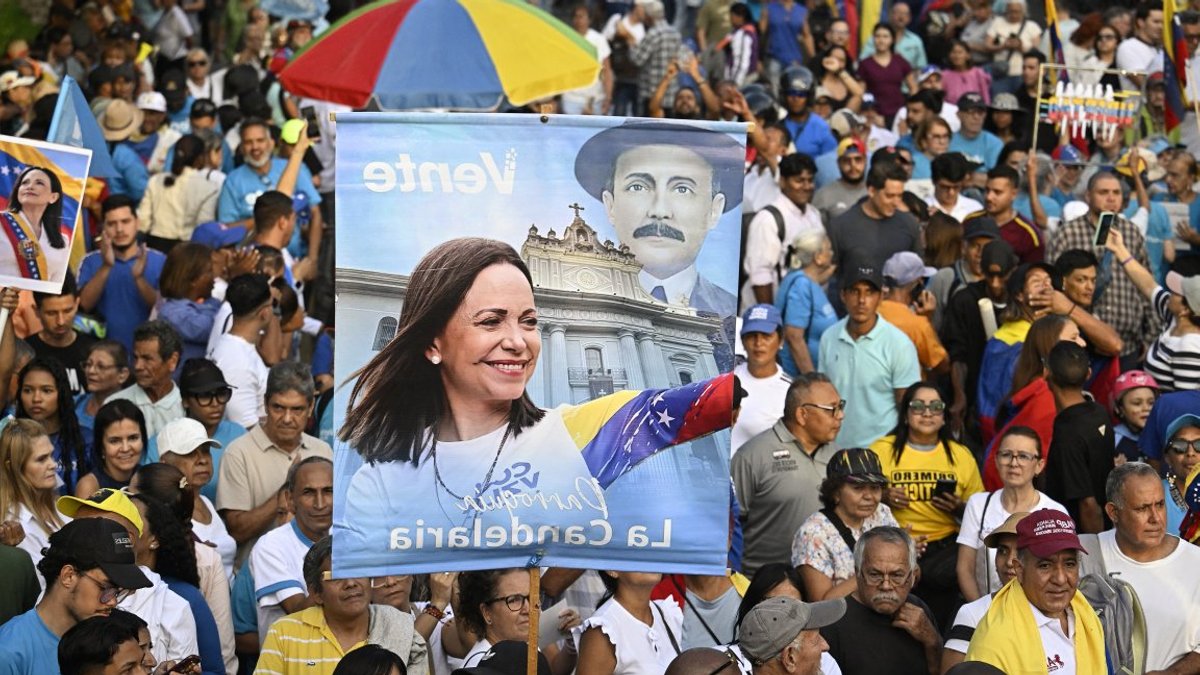
The return of 2025 Nobel Peace Prize laureate and prominent Venezuelan opposition leader María Corina Machado to her home country has introduced significant uncertainty into U.S.-Venezuela relations. Machado confirmed her arrival on Sunday after months in exile, posting on X that she was “here. With you.” The news was swiftly corroborated by her close political ally, Edmundo González Urrutia, who declared on the platform that their “sovereign voice returns with her to lead and guide this process.”
A Disruptive Force in the Oil Deal
Her reappearance will likely inconvenience the current Venezuelan leadership and threatens to undermine improving relations between the administrations of President Donald Trump and current Venezuelan President Delcy Rodríguez. The two governments signed a landmark oil agreement in late August, granting a U.S.-led company, North American Blue Energy Partners (NABEP), 100-year concessions over 17 Venezuelan oilfields. At the time, President Trump called the deal “the biggest oil deal in world history.” Venezuela holds the largest proven oil reserves of any nation, a fact that makes the outcome of this political development key for global energy markets.
Read Also: Israel election poll split leaves Ofer Winter’s party on razor
Machado was nominated to be the opposition’s candidate in the 2024 elections against long-serving autocrat Nicolás Maduro, but she was barred from running. González Urrutia was selected instead and was widely recognized by independent observers as the true victor of the vote, though the government-controlled National Electoral Council declared Maduro the winner. Facing governmental harassment following the contested result, Machado spent over a year in hiding in Venezuela before leaving in December 2025 to collect the Nobel Prize. She had styled herself as an ally of the U.S., a position viewed unfavorably by the Venezuelan government, which has been an adversary of Washington since the election of socialist critic Hugo Chávez in 1999.
Tensions reached a peak in January when U.S. forces abducted Maduro and forcibly extradited him to the U.S. to face charges of narcotrafficking and conspiracy to commit torture. Maduro’s Vice President, Delcy Rodríguez, assumed the presidency in an interim capacity and has since formed a much closer relationship with Washington than her predecessor, a partnership solidified by the oil agreement. Following Maduro’s ouster, it was widely anticipated that the Trump administration would support Machado in a bid to assume leadership. However, Trump claimed she lacked internal support, and reports indicated that the U.S. had even ordered a jet carrying Machado to return to the U.S. as she attempted to enter the country following deadly earthquakes.
Read Also: Russian Diesel Shipment Heads to US
The Future of the Oil Deal and Venezuelan Leadership
Delcy Rodríguez has stated that elections will occur in Venezuela as part of a democratic transition, but the date for the vote remains unspecified. It also remains unclear whether Machado would be eligible to run for office if such an election took place. The opposition leader has also not clearly defined her stance on the oil agreement signed between Washington and Caracas.