

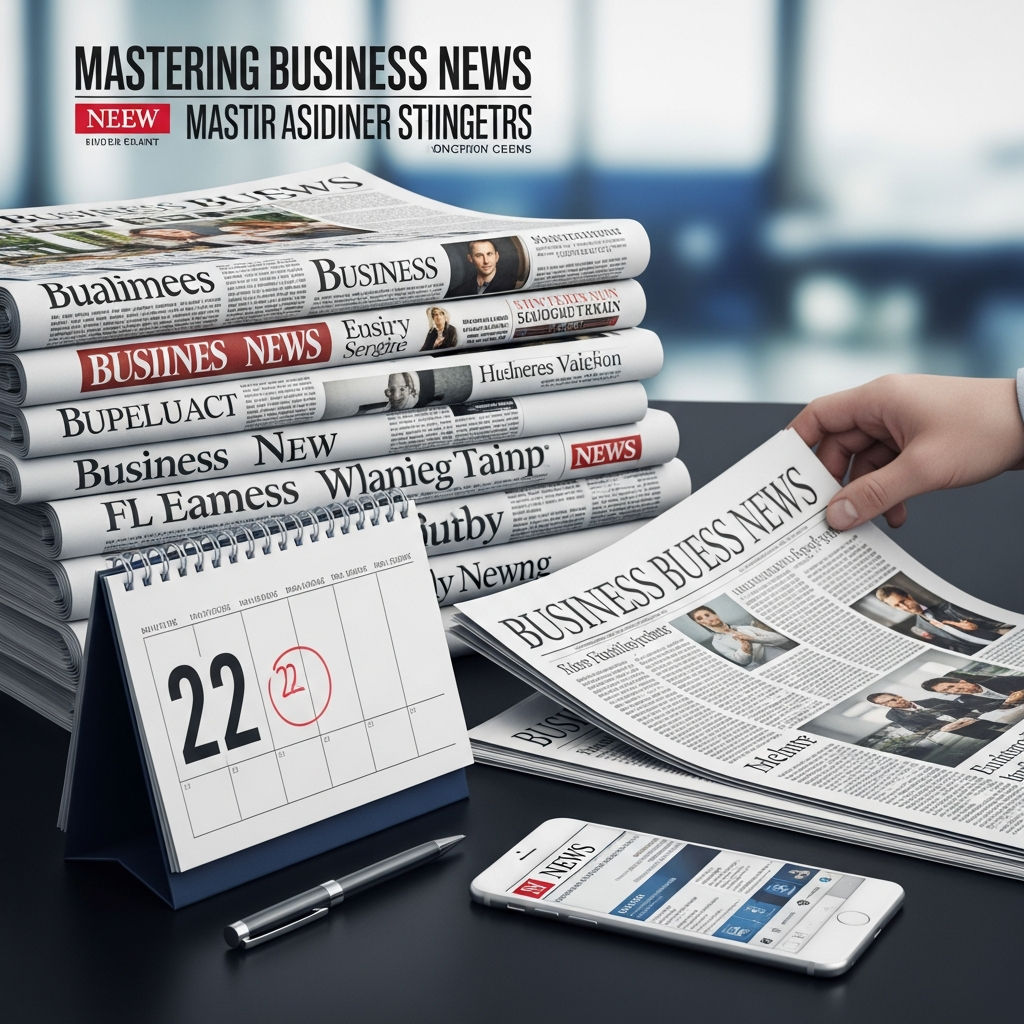
Mastering Business News: A 22-Day Roadmap to Financial Literacy
In today’s hyper-connected economy, staying informed isn’t just a hobby—it is a competitive advantage. Whether you are an aspiring entrepreneur, a corporate professional, or a retail investor, the ability to decode business news allows you to anticipate market shifts, identify opportunities, and mitigate risks. However, the sheer volume of financial data can be overwhelming for the uninitiated.
The good news is that financial literacy is a skill that can be developed. By following a structured 22-day plan, you can transform from a casual headline-skimmer into a savvy market observer. This guide breaks down the process into three distinct phases: building a foundation, understanding market mechanics, and synthesizing complex global events.
Phase 1: Building the Foundation (Days 1–7)
The first week is about overcoming “jargon fatigue” and establishing a reliable intake system. Business news often feels like a foreign language because of its specialized vocabulary.
Day 1: Audit Your Information Sources
Start by identifying high-quality sources. Not all business news is created equal. Diversify your intake by bookmarking reputable outlets such as The Wall Street Journal, Financial Times, and Bloomberg. Avoid “clickbait” financial blogs that focus on sensationalism rather than structural analysis.
Day 2-3: Deciphering the Vocabulary
Spend these two days learning the “Big Five” terms: Inflation, Interest Rates (The Fed), GDP, Bull/Bear Markets, and Fiscal vs. Monetary Policy. Understanding these concepts is essential because they form the backdrop of every business story you will ever read.
Day 4-5: Understanding Corporate Financials
Pick a public company you admire (e.g., Apple or Tesla) and look up their latest earnings report. Focus on three metrics:
- Revenue: The total money coming in.
- Net Income: The profit left over after all expenses.
- EBITDA: A measure of operational performance.
Understanding how a company makes and keeps money helps you see past the PR spin of corporate announcements.
Day 6-7: The Role of the Central Banks
The Federal Reserve (in the US) or the ECB (in Europe) are the most powerful players in the business world. Use these days to study how interest rate hikes or cuts impact the economy. When the “Fed” speaks, the markets move. Learn why.
Phase 2: Understanding Market Mechanics (Days 8–14)
Now that you have the vocabulary, it is time to see how the pieces move together. Week two focuses on indices, sectors, and the psychology of the market.
Day 8-9: Decoding the Major Indices
When news anchors say “the market is up,” they are usually referring to indices. Spend time understanding the differences between:
- The S&P 500: The 500 largest companies in the US (the best general health indicator).
- The Dow Jones: 30 “blue-chip” industrial giants.
- The NASDAQ: Heavy on technology and growth stocks.
Recognize that these indices represent different segments of the economy.
Day 10-11: Sector Rotation and Industry Trends
The economy is divided into sectors like Energy, Healthcare, Tech, and Consumer Staples. Notice how news affects them differently. For example, rising oil prices might hurt airlines (Transport sector) but benefit ExxonMobil (Energy sector). Learning to think in “sectors” helps you narrow down where the most important news is happening.

Day 12-13: The Impact of Geopolitics
Business news does not exist in a vacuum. Trade wars, elections, and international conflicts have immediate financial repercussions. Practice “cause and effect” thinking: if a major shipping lane is blocked, which industries will see their supply chains disrupted? How will that affect their stock price?
Day 14: Analyzing Economic Indicators
Review the calendar for “Jobs Friday” (the Non-Farm Payrolls report) or Consumer Price Index (CPI) releases. These reports are the heartbeat of business news. Observe how the market reacts to the “actual” number versus the “expected” number.
Phase 3: Synthesis and Strategic Thinking (Days 15–21)
In the final week, you will move from understanding “what” is happening to “why” it is happening and “what comes next.”
Day 15-16: The Art of the Contrarian View
For every business news story, there is often a counter-argument. If a headline says “Retail is Dying,” look for stories about the resurgence of physical boutiques. Mastering business news requires seeing both sides of the coin to avoid the “herd mentality.”
Day 17-18: Following the Money (Venture Capital and M&A)
Focus on Mergers and Acquisitions (M&A). When one company buys another, it signals where an industry is heading. Look at the premiums paid and the strategic reasoning behind the deal. Is it for technology, talent, or market share?
Day 19-20: Emerging Technologies and ESG
Modern business news is dominated by two themes: AI (Artificial Intelligence) and ESG (Environmental, Social, and Governance). Spend these days understanding how these long-term trends are forcing legacy companies to pivot their business models.
Day 21: Developing Your “Filter”
By now, you should realize that 80% of business news is “noise.” Practice filtering out daily price fluctuations and focus on structural shifts. If a stock drops 2% because of a tweet, that is noise. If it drops 20% because of a regulatory change, that is news.
Day 22: The Master Review and Habit Formation
Congratulations! You have completed the intensive 22-day sprint. Today is about cementing your new routine. To maintain your mastery, you must move from active learning to consistent habit formation.
Your New Daily Business News Routine:
- Morning (15 mins): Listen to a business news podcast (e.g., The Journal or FT News Briefing) while commuting or exercising to get the “top stories.”
- Mid-Day (10 mins): Scan a newsletter (like Morning Brew or Quartz) for a summarized view of market movements.
- Evening (20 mins): Read one deep-dive long-form article or an “Opinion” piece to understand the nuances behind the headlines.
Key Takeaways for Long-Term Success
Mastering business news is not about memorizing ticker symbols; it is about understanding the incentives that drive human behavior and corporate decisions. As you continue your journey, keep the following principles in mind:
- Stay Curious: If you see a term you don’t know, look it up immediately.
- Be Skeptical: Always ask, “Who benefits from this news being published?”
- Connect the Dots: Try to link a tech story to a political story to an economic story. The world is an ecosystem.
By dedicating just 22 days to focused learning, you have equipped yourself with a mental framework that will serve you for the rest of your career. In the world of business, knowledge isn’t just power—it’s profit, stability, and foresight.